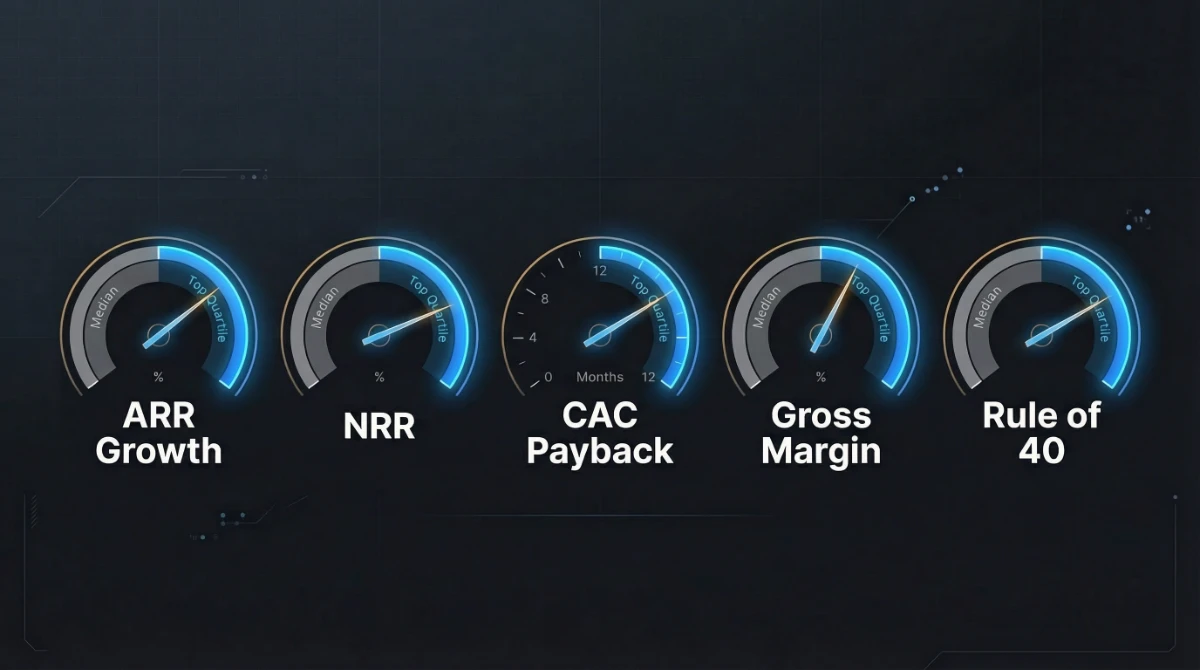
If your SaaS company grew 26% last year, you hit exactly the median. Not strong. Not weak. Median.
That number, confirmed across Benchmarkit’s 2025 SaaS Performance Metrics dataset and corroborated by SaaS Capital’s private company research, is the new baseline. The top quartile sits at 50% — down from 60% in 2023. The floor has moved, and so has the ceiling.
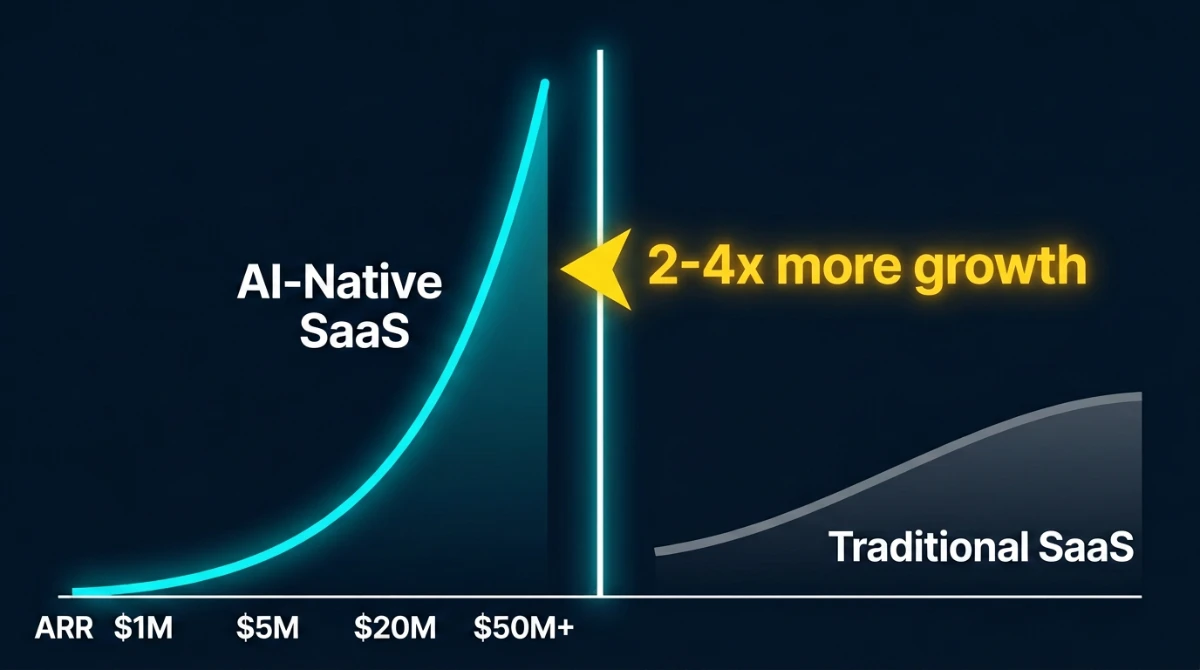
More importantly, the data reveals a gap that’s growing faster than most founders and CEOs realize: AI-native companies — those where AI is architecturally core to the product — are growing at roughly twice the rate of their traditional or lightly-AI-enabled peers, across every ARR band. That gap isn’t narrowing. It’s widening.
Here’s what the benchmarks say, what they mean, and where you should act.
The New Growth Baseline
Median year-over-year ARR growth for private SaaS companies is 26%. VC-backed companies are tracking at 25–30% at the median, with bootstrapped firms closer to 20–23%.
The top quartile threshold has compressed from 60% in 2023 to 50% today. That compression matters: the gap between “good” and “great” is shrinking in the traditional SaaS world, while the gap between traditional SaaS and AI-native companies is expanding.
One more number that should concern anyone relying on new customer acquisition: the new customer CAC ratio has hit $2.00 per $1 of new ARR — up 14% year-over-year. Acquiring new logos is getting meaningfully more expensive.
Retention Is Now the Growth Engine
Net Revenue Retention sits at 101% across the median. Top performers are at 111%+. Gross Revenue Retention has stabilized around 88–90%.
The expansion story is more revealing. Expansion ARR now accounts for 40% of total new ARR across all companies. For companies above $50M ARR, that figure exceeds 50–60%.
This isn’t a coincidence. It’s a structural shift in how SaaS businesses grow. The companies posting the best Rule of 40 scores — an average of 47% for top performers — are the ones with high NRR and fast CAC payback. Companies with low NRR and slow payback are averaging a Rule of 40 score of just 5%.
If you’re still treating expansion as a secondary motion, your growth model is misaligned with where the market has moved.
CAC Payback Is ACV-Dependent
Payback periods vary significantly depending on deal size — the industry median is 18 months overall, but that masks real differences:
| ACV Range | Median CAC Payback |
|---|---|
| < $5K | 8 months |
| $5K–$25K | 14–18 months |
| $25K–$50K | 22 months |
| > $50K | 24 months |
If you’re selling mid-market or enterprise, a 22–24 month payback means your revenue model only holds if retention is airtight. These numbers make high churn existential at those price points.
The AI-Native Performance Gap Is Real and Large
High Alpha’s analysis of 800+ SaaS companies is the clearest picture yet of what AI-native companies are doing differently:
| ARR Band | AI-Native Median Growth | Traditional/AI-Supporting | Multiple |
|---|---|---|---|
| $1–5M | 110% | 40% | ~2.75x |
| $5–20M | 90% | ~34% | ~2.7x |
| $20–50M | 60% | 35% | ~1.7x |
| > $50M | 38% | 16% | ~2.4x |
The multiplier holds across every scale. And it’s not just growth — AI-native firms also post stronger Rule of 40 scores, even accounting for the slightly lower gross margins that come with inference costs.
The conclusion isn’t that you need to rebrand as an AI company. It’s that companies where AI is core to the product architecture — not bolted on as a feature — are pulling away. Shallow AI integrations aren’t moving the needle on these metrics.
What’s Happening on the Buyer Side
The Zylo 2026 SaaS Management Index tracks over $30B in SaaS spend under management. The buyer-side data adds a layer that the supplier-side benchmarks miss.
Average enterprise SaaS spend has reached $55.7M per organization — up 8% year-over-year — while average portfolio size has barely moved, holding flat at 305 applications. Spend is rising without sprawl. The driver is AI-native application spend, which jumped 108% year-over-year for the average enterprise and 393% for large enterprises.
That’s the demand signal for AI-native vendors.
The risk signal for everyone: 78% of IT leaders reported unexpected mid-contract charges tied to AI features or consumption-based pricing. 61% had to delay or cut projects because of unplanned SaaS cost spikes. Usage-based pricing volatility is creating real budget pain, and procurement teams are starting to push back harder at renewals.
If your pricing model involves consumption-based or AI-usage tiers, your customers are likely already exposed to this dynamic. How you communicate cost predictability is becoming a meaningful part of your retention story.
Good vs. Great: The 2026 Scorecard
| Metric | Good (Median) | Great (Top Quartile / AI-Native) |
|---|---|---|
| YoY ARR Growth | 26% | 50%+ |
| Net Revenue Retention | 101% | 111%+ |
| CAC Payback (low ACV) | 18 months | < 12 months |
| Gross Margin | ~75% | 75%+ |
| Rule of 40 | ~40% | 47%+ |
Hitting “good” on all five used to be a strong outcome. Today, it’s table stakes for fundraising conversations and competitive positioning.
What This Means for Your Role
Founders and CEOs: The Rule of 40 discipline has arrived in earnest. Investors in 2026 are rewarding precise financial visibility and AI-leveraged efficiency — not raw top-line growth. If you’re not tracking NRR and CAC payback at the cohort level monthly, you’re making decisions on data that’s too slow. Spreadsheet-based reporting is the main culprit at early stage; fix that before your next board meeting.
CTOs and product leaders: The AI-native growth premium is architectural, not superficial. If AI in your product is primarily a feature layer — a chatbot on top of existing functionality — the benchmarks suggest you’re not getting the compounding advantages. The question worth asking internally: where in our core product logic is AI doing work that changes the customer outcome?
GTM and marketing leaders: With new customer CAC up 14% and expansion ARR now driving 40–60% of growth, the shift in budget allocation is clear. Channel spend that targets existing customers for upsell and cross-sell needs to be a primary motion, not secondary. The B2B SaaS marketing playbook is changing to reflect this — retention-adjacent demand gen isn’t a trend, it’s now a structural requirement.

The One Decision to Make
These benchmarks define the competitive landscape. The question they force is simple: which quadrant are you in?
Companies with high NRR and fast payback are averaging 71% growth and a 47% Rule of 40 score. Companies in the low-NRR, slow-payback quadrant are averaging 10% growth and a Rule of 40 of 5%. That’s not a performance difference — it’s a different business.
Pick your target quadrant. Map every major initiative for the next two quarters against whether it moves you toward it. If you find that most of your roadmap is oriented toward acquiring new logos instead of retaining and expanding existing ones, that’s the misalignment to correct first.