Today, OpenAI announced it has raised $110 billion in new capital at a $730 billion pre-money valuation — roughly $840 billion post-money. That’s more than double its March 2025 round, which raised $40 billion at a $300 billion valuation, and marks the largest private funding round in tech history.
The breakdown: Amazon is investing $50 billion (starting with $15 billion now, with another $35 billion to follow once certain conditions are met), while NVIDIA and SoftBank are each putting in $30 billion. The round remains open for additional investors.
The OpenAI Foundation’s stake in the for-profit entity is now worth over $180 billion — money that will go toward its nonprofit mission in health research and AI safety.
The Partnerships Matter More Than the Dollar Amount
This isn’t just a giant check. Each investment comes with a strategic deal that changes how OpenAI builds, distributes, and runs its products.
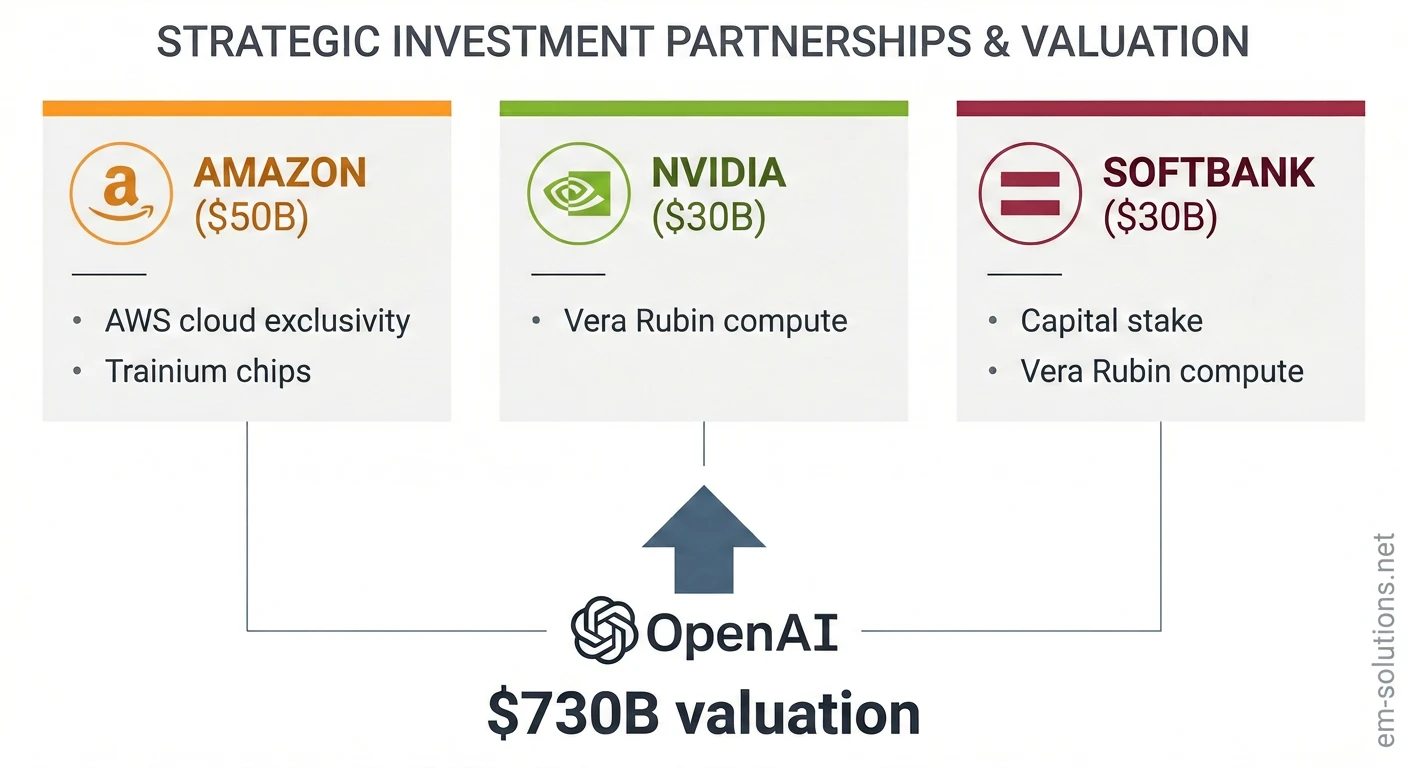
Amazon is becoming the exclusive third-party cloud provider for OpenAI’s enterprise platform, Frontier, which businesses use to build and deploy AI tools for engineering, support, finance, and operations.
The partnership also includes OpenAI committing to consume approximately 2 gigawatts of Amazon’s Trainium chips, and an expansion of their existing $38 billion AWS contract by another $100 billion over eight years.
Both companies are also jointly developing a “Stateful Runtime Environment” — essentially a persistent, context-aware setup for running OpenAI models on Amazon’s Bedrock platform — that will launch in the coming months. Amazon CEO Andy Jassy called it “a very strong, long-term partnership.”
NVIDIA gets 3 gigawatts of dedicated inference capacity plus 2 gigawatts of training on its next-generation Vera Rubin systems. This builds on the existing Hopper and Blackwell setups already running across Microsoft, Oracle, and CoreWeave.
Microsoft is unaffected. Both companies issued a joint statement today confirming their partnership remains “strong and central,” with Azure still hosting first-party OpenAI products under unchanged terms.
What OpenAI Looks Like Right Now
A few numbers worth knowing as context for this raise:
ChatGPT has 900 million weekly active users and over 50 million paying consumer subscribers, with January and February 2026 on track to be the biggest months for new sign-ups in company history.
More than 9 million paying business users rely on the platform for work. Codex, the software development tool, now has 1.6 million weekly users — more than triple what it had at the start of the year.
On the financial side, OpenAI generated $13.1 billion in full-year 2025 revenue, and by year-end its annualized run rate had crossed $20 billion. The company is burning through roughly $8 billion a year and is targeting around $600 billion in total compute spend by 2030. Profitability is not expected until that timeline approaches.
What This Means If You’re Building or Leading Something
For CTOs and technical leaders: If you’re on AWS, the new Frontier platform and the Bedrock Stateful Runtime integration just became the fastest path to production-grade OpenAI agents. Start evaluating it now, not after your competitors already have.
On the compute side, Trainium and GPU capacity will get tighter as OpenAI locks up supply at scale — if you have significant AI workloads, get your cloud commitments sorted before mid-year.
For founders and startup CEOs: The gap between building on OpenAI’s infrastructure and competing against it is widening. With Amazon’s distribution reach plus OpenAI’s model capabilities, you’re now selling to buyers who may already have a solution waiting in their existing cloud contract. The question isn’t whether to engage with this ecosystem — it’s how to build something defensible within it, or alongside it.
For marketers and growth executives: 900 million weekly users means ChatGPT is infrastructure, not a novelty. Any marketing or growth workflow that hasn’t accounted for personalization and automation at this scale is already running behind. Watch the Frontier case studies that will come out of enterprise deployments — they’ll move fast and set new benchmarks.
For investors and board members: The circular dynamic here is worth noting: large tech companies invest in OpenAI, OpenAI buys their chips and cloud, and the flywheel keeps spinning. Multiple reports also point to a major OpenAI IPO later in 2026. This round significantly de-risks that path.
The Honest Risks
The valuation is striking even by current standards, and profitability is still years away. OpenAI is targeting $600 billion in compute spend by 2030 — a number that requires revenue growth few companies in history have ever pulled off.
Regulatory scrutiny is a real variable too. Antitrust watchers are already asking questions about the Amazon deal and whether the circular investment model between Big Tech and OpenAI warrants attention. Energy consumption is another pressure point — running this infrastructure takes gigawatts of power.
And the competition isn’t standing still. Anthropic, Google, xAI, and Meta each have deep-pocketed backers and serious model capabilities. OpenAI’s lead is real, but not guaranteed.
The 30-Day Checklist
- Request a Frontier demo through your AWS account team.
- Revisit your 2026 AI compute budget — model it at 2x to 3x current spend.
- Run an internal audit: which workflows can realistically be automated or assisted with today’s OpenAI capabilities?
- Brief your board on what this valuation benchmark means for your competitive positioning and your own AI roadmap.
The window to treat AI as something to watch is closed. The question now is how fast you move.