At XChange March 2026, Jennifer Roy of Nucleus Networks said the quiet part out loud: “If you’re not having those AI conversations with your clients, another MSP is.” That framing gets misread as urgency to ship an AI product fast. It’s actually urgency to do something much harder — figure out what kind of business you’re building before the window closes.
The demand signal is not the problem. Every credible piece of channel research this year agrees that AI is at the top of client conversations. The problem is that most MSPs are walking into those conversations without a clear service model, without defensible pricing, and without the internal proof points to back up what they’re promising. That gap — between demand and readiness — is where the real story of the MSP market in 2026 lives.
A Market Growing in Two Directions at Once
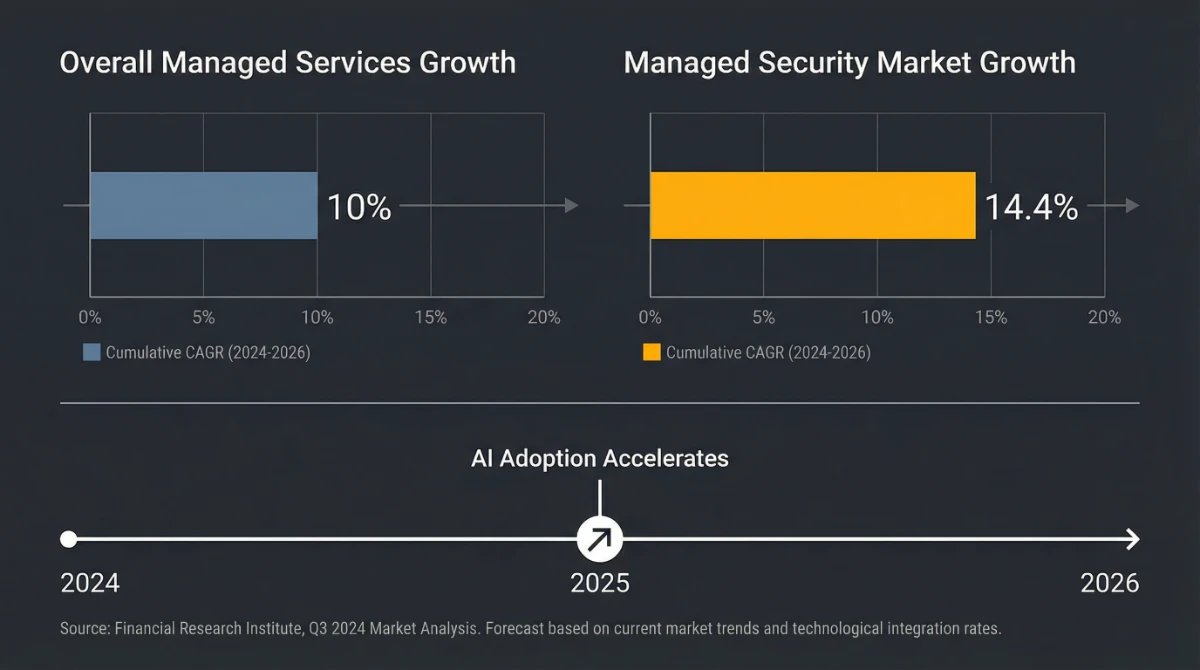
Omdia’s MSP Trends and Predictions 2026 projects overall managed services market growth at just 10% this year — below historical norms. The drag comes from a familiar set of forces: clients under budget pressure, basic helpdesk and per-user services fully commoditised, and AI-driven licensing costs that MSPs are expected to absorb without raising prices.
Set that against ScalePad’s 2026 MSP Trends Report, which surveyed over 1,100 MSP professionals and found 55% projecting double-digit revenue growth and 87% describing themselves as optimistic. These numbers aren’t contradictory — they’re describing two different groups operating in the same market.
The separation happening right now is between MSPs still primarily in the business of keeping things running and MSPs who have moved — or are actively moving — into advisory, security, and AI-enabled services.
The first group is fighting a margin compression story. The second group is looking at a managed security market projected to grow 14.4% in 2026, from $93 billion to $106 billion globally (Omdia). That gap in growth rates is the single most important structural fact in the channel this year.
There is no middle ground. Commoditised IT management gets cheaper to deliver every year — which means it also gets cheaper to buy, and margins go one direction. The MSPs who understand this are making explicit choices about which side of that line they want to be on.
Deploy AI Internally First. That’s Not a Warm-Up — That’s the Strategy.
The most common mistake MSPs are making with AI is trying to monetise it externally before they’ve actually understood it internally. It’s backwards. The MSPs with the strongest AI service offerings in 2026 are the ones who spent 2025 running AI inside their own operations.
The ROI data from those deployments is now concrete. Leading MSPs report 15 to 25% technician productivity gains and 40 to 70% reductions in ticket resolution times through internal AI adoption (Omdia).
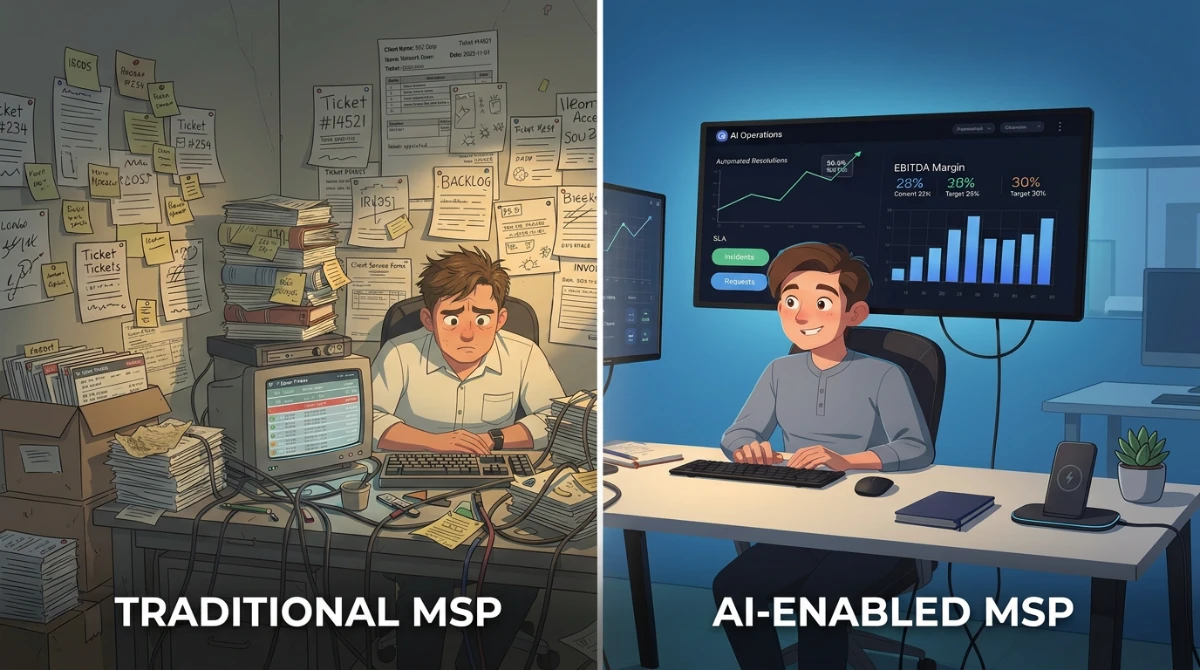
The automation-first MSPs running AI across tier-1 ticket handling, monitoring, and knowledge management are operating at EBITDA margins of 18 to 22%, compared to the industry average of 11 to 14%. That’s not a small operational improvement — it’s a different business model.
The practical implication is significant: internal deployment creates the financial headroom to hire better technical talent, absorb the cost of new service development, and take on clients the undifferentiated MSP simply can’t afford to serve well. It also gives you something genuinely valuable in client conversations — not a pitch deck, but actual performance data from your own environment that makes the AI ROI story credible.
The MSPs still treating internal AI tooling as optional are making a mistake that compounds. Every quarter they delay, the gap between their operating economics and the top performers’ widens.
Why AI Pricing Keeps Breaking — and What Actually Holds
Here’s where most coverage of the MSP AI opportunity goes shallow. Demand is acknowledged. Opportunity is affirmed. The pricing reality gets a sentence or two.
Jennifer Roy described it plainly at XChange: they found out after the fact that a deal had no profit in it, repriced, and tried again. Jatin Mehta’s recommendation — pricing AI services on a time and labour basis rather than a fixed-cost basis — is the most practically sound advice in the channel right now. The reason matters.
AI services have a fundamentally different cost structure than traditional managed services. Token costs fluctuate. Model upgrades change cost-per-task economics overnight. A fixed-rate AI bundle that’s profitable today may not be profitable in 90 days if the underlying model changes or client usage scales. MSPs who’ve priced AI like they price per-user helpdesk contracts are absorbing costs they didn’t model.
The pricing model that’s proving most durable is a hybrid: a base retainer covering ongoing advisory and governance, with variable billing tied to actual AI consumption and specific outcomes. This isn’t just margin protection — it’s alignment.
Clients who understand they’re paying for outcomes rather than a fixed service have a different relationship with cost. They’re evaluating value, not comparing line items.
Getting here requires cost data from your own deployments. You cannot build a defensible pricing model for AI services without knowing what it actually costs you to deliver them. That’s the other reason internal deployment comes first — not just to build credibility with clients, but to build the financial model that lets you price the work honestly.
Shadow AI: The Risk That Opens the Conversation
One of the most practically useful observations from the XChange panel came from Jennifer Roy: “You could lose your IP because of someone who’s put it out in OpenAI.” Most MSPs have nodded at that risk. Very few have built a service around solving it.
The scale of shadow AI inside client organisations is not a fringe concern. Research consistently finds that the majority of employees who use AI tools in their work do so with tools that haven’t been reviewed or approved by IT.
They’re pasting source code, client records, and internal documents into systems with no data governance, no audit trail, and no contractual protection. Not out of malice — because they’re trying to work faster and no one has given them a governed alternative.
The exposure is concrete. For healthcare clients, inputting patient data into an unauthorised AI tool is a HIPAA violation regardless of intent. For financial services firms, it creates regulatory and data sovereignty problems immediately. Cyber insurers are already responding — treating unmanaged AI tool usage the way they treat missing MFA: grounds to deny coverage or raise premiums.
The MSP opportunity here is not just risk mitigation. It’s positioning. An MSP that walks into a client conversation with a shadow AI audit — here’s every AI tool your employees are using, here’s the risk classification, here’s a governance framework to manage it — is not being a vendor. They’re being an advisor.
That is the relationship that commands premium pricing, creates switching costs, and naturally expands into compliance, security monitoring, and strategic advisory over time.
This is also the most direct bridge to the broader AI conversation. Clients who understand they have an unmanaged AI problem are far more receptive to a structured AI strategy. Shadow AI governance is not the end of the conversation — it’s how you start the right one.
The Security and Compliance Bundle Is the Most Defensible Position in the Channel
Cybersecurity is already the most-delivered MSP service (55%) and the top stated priority for expansion (41%) — which means it’s also increasingly table stakes. The question is no longer whether an MSP offers security. It’s whether their security offering is differentiated enough to justify a premium.
The differentiation opportunity lives in two places. First, AI-assisted detection and response. Organisations using AI in cybersecurity are meaningfully faster at identifying and containing threats — a metric that translates directly into lower client exposure and lower insurance risk. That’s a concrete value story in every client conversation, not a feature claim.
Second, compliance as a managed service. Only 36% of MSPs currently offer formal compliance services, despite the fact that compliance-focused MSPs are significantly more likely to project revenue growth above 50% in 2026 (ScalePad). The reason is straightforward: compliance engagements require ongoing advisory relationships, create genuine switching costs, and anchor the MSP at a strategic level in the client’s operations.
It’s also where regulation and insurance pressure is driving demand without any sales effort required — the EU AI Act is now enforceable, and cyber insurers are acting as de facto regulators, requiring foundational controls as a condition of coverage.
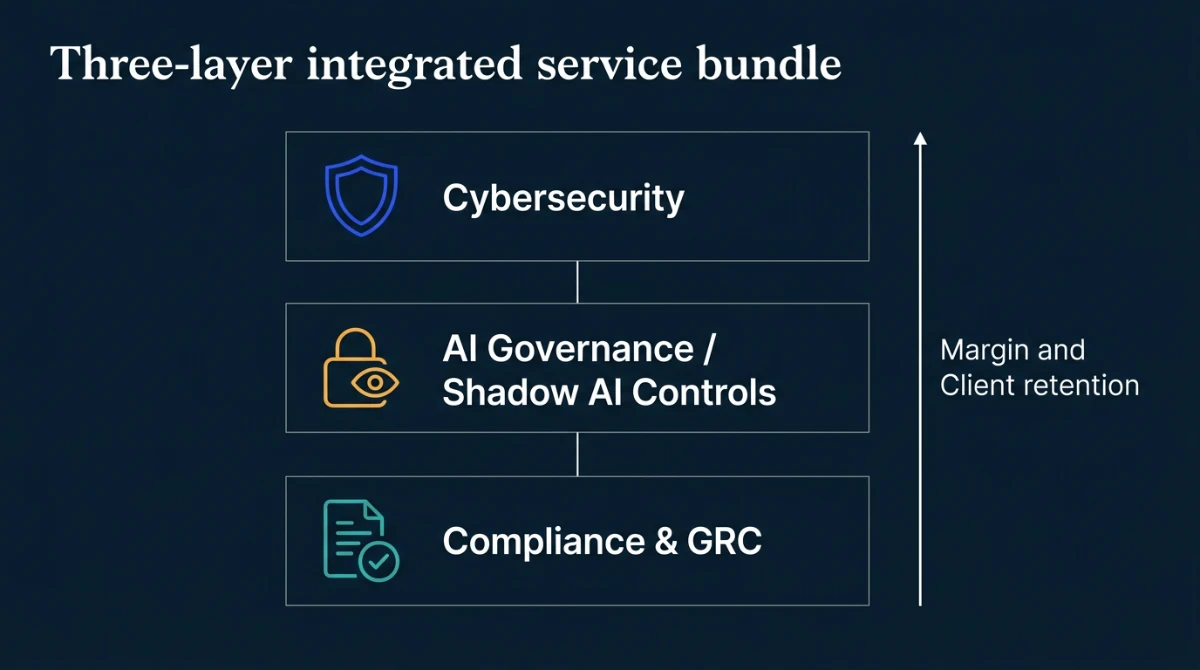
The bundle that makes strategic sense — security, AI governance, and compliance wrapped into a single advisory engagement — is not yet standard. That’s the opportunity. The MSPs building that offer now, with actual depth in each layer, are constructing a position that a helpdesk-first MSP cannot quickly replicate.
For a closer look at how enterprise organisations are adapting to AI governance pressure — and what they’re asking their technology partners to solve — see our piece on How Agentic AI is Changing Enterprise Software in 2026.
The Staffing Problem Doesn’t Go Away — It Gets Managed
Growth projections and service model ambitions run into a structural ceiling for most MSPs: there aren’t enough skilled people to deliver the work. ScalePad’s data is direct — 26% of MSPs say they lack the staff to service more clients, 22% can’t find qualified people to offer new services, and 21% are running at utilisation above 75%, a reliable predictor of both burnout and service degradation.
This isn’t a hiring problem with a hiring solution. IT unemployment is effectively at full employment, which means you’re recruiting from people who already have jobs. Cybersecurity analysts and cloud architects command salaries that smaller MSPs struggle to compete with against enterprise employers.
The MSPs navigating this well are not trying to out-hire the problem. They’re using internal AI deployment to multiply the effective capacity of the teams they have — automating tier-1 ticket handling, monitoring, and incident triage so engineers can focus on work that requires actual judgment.
That’s where the 15 to 25% productivity gain figure becomes strategically important. It’s not just a margin story. It’s a growth enabler. An MSP that can take on more clients without a proportional headcount increase has a fundamentally different growth equation.
The talent strategy that follows from this is also different. You’re not trying to hire more people who do what your team already does. You’re hiring people who think like consultants — who can sit in a client conversation, identify the business problem behind the technical question, and translate it into a service engagement. That’s the profile that justifies vCIO rates, and it’s the profile that the top performers are deliberately building toward.
What This Means for You
If you run an MSP: Three decisions define 2026. First, deploy AI inside your own operations this quarter — not as a pilot, but as a genuine commitment. Document what changes. You need real cost and productivity data before you can price AI services without guessing. Second, build a bundled security, AI governance, and compliance offering.
The managed security market is growing at 14.4% while overall MSP growth sits at 10% — that spread is your business case for where to focus. Third, move at least part of your team into advisory and vCIO services. The top performers are 13 percentage points more likely to offer vCIO services than the average MSP, and the correlation with higher recurring revenue and retention is not coincidental.
If you’re a CTO or executive buying managed services: The quality gap between MSPs is widening faster than most buyers realise. Ask your provider directly: what’s your AI roadmap for our environment, what controls are in place for shadow AI, and can you show us your own internal AI performance data? If the answer is vague, that’s a signal — either about what to demand or about where to look.
The OpenAI funding round and its implications for enterprise AI infrastructure is also worth understanding in this context: the technology landscape your MSP should be navigating on your behalf is moving quickly.
The Window Is Real, but It’s Not Infinite
The managed services market has been through transitions before. Cloud, remote management, cybersecurity — each one separated the MSPs who moved early from those who reacted late. The pattern repeats.
What’s different about AI is the pace. The MSPs who have internal deployments running, cost models built, and client-facing AI governance services packaged in 2026 will have a market position and a proof-of-work record that competitors will struggle to replicate in 2027 — not because the technology is inaccessible, but because the operating experience and the client trust that comes with it takes time to build.
Every client is already asking the AI question. The only variable is which MSPs will have a real, credible answer — and which will still be working on one.