If your company runs on IBM — and statistically, there’s a good chance it does — something significant just happened.
On 17 February 2026, IBM announced a wave of AI agents being built directly into Db2, MQ, Sterling Order Management, Cognos, and several other core enterprise products. The first ones go live in March. They’re included in existing licences. And if they work as advertised, they solve a problem most large enterprises are quietly suffering from: their most critical software is also their hardest to manage.
The Problem IBM Is Actually Solving
Most enterprise software wasn’t designed to be self-explanatory.
A Db2 database running a bank’s transaction system. An MQ messaging environment coordinating a retailer’s order flow. These things work — they’ve worked for decades — but when something goes wrong, fixing it takes specialists. Senior ones. Ones who are increasingly hard to hire and easy to lose.
When an MQ queue backs up and nobody knows why, the answer usually involves someone with 10+ years of experience, a lot of log files, and a few hours. When a Db2 query starts spilling to disk and performance degrades, the same applies.
IBM’s bet with this rollout is simple: what if you could ask the system what’s wrong, in plain English, and get a useful answer in minutes?
What the Agents Actually Do
The best way to understand this is to focus on two products — Db2 and MQ — where the agent rollout is most substantial.
Db2 gets over a dozen specialized agents. The most immediately useful ones are probably the Telemetry Agent, which gives you conversational access to live monitoring data (spot anomalies, get recommendations, understand trends — through a chat interface), and the Text to SQL Agent, which lets anyone describe what data they want in plain English and get working Db2 SQL back.
For operations, there’s an agent called Change Guard that connects system changes to health indicators — so when something breaks after a config update, you find out faster why. Support Prep runs proactive monitoring to catch issues before they escalate. Spill Guard and Queueing agents handle the specific performance patterns that tend to quietly degrade query performance over time.
The overall effect, if it works, is a database that’s far less dependent on a small number of experts to stay healthy. That’s genuinely useful.
MQ gets a cleaner, more focused set of agents. The Supervisor Agent is the entry point — you talk to it in natural language, it coordinates everything else. Behind it, specialized agents handle the most common MQ headaches: message buildup, application-level delays, channel issues, and dead-letter queue problems.
IBM’s stated goal is to cut the time to answer “why aren’t messages flowing?” from hours to minutes. If you’ve ever been on the wrong end of an MQ outage at 2am, you know exactly what that’s worth.

Sterling and the Rest of the Stack
Sterling Order Management (GA: 6 March) gets agents built specifically for the pain points of omnichannel commerce: order information lookup, coupon policy enforcement, inventory allocation, and contract risk assessment. The Inventory Segmentation Agent is interesting — it continuously rebalances allocation in real time, not on a scheduled batch. For retailers managing both physical and digital fulfilment, that’s a meaningful operational improvement.
The broader rollout also touches Cognos Analytics (reporting agents that automate the tedious parts of distributing and summarizing reports), Cloud Pak for Integration (Kubernetes management without needing deep Kubernetes expertise), App Connect Enterprise (integration modernization and change management), Sterling B2B Integration SaaS (visibility into high-volume partner transactions), and Engineering Lifecycle Management (auto-drafting of user stories and work items).
None of those are the headline, but all of them chip away at the same underlying problem: these products are powerful and widely deployed, but they create operational drag that costs real money.
The Architecture Worth Understanding
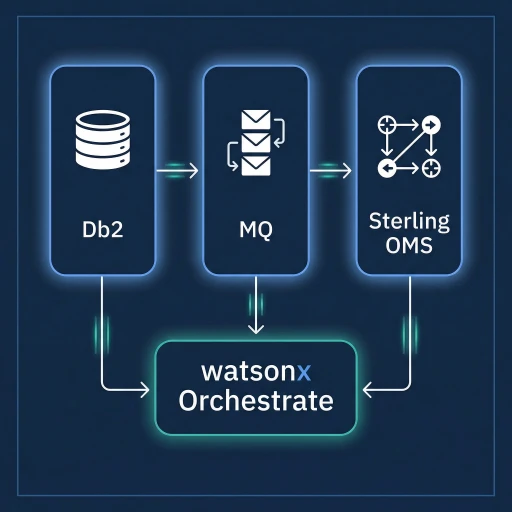
All of this connects to watsonx Orchestrate, IBM’s multi-agent orchestration layer. That matters because individual product agents are useful, but the longer-term value is cross-product workflows — an order-to-cash process where Sterling, Db2, and your integration layer are all coordinating through agents without a human passing data between systems.
IBM is also using the Model Context Protocol (MCP) for agent-to-agent communication. MCP is an open standard that’s been gaining traction across the industry for exactly this reason — it makes it easier to build agent systems that work across different products and vendors without custom glue code everywhere.
For regulated industries, both of these choices matter. The agents operate within IBM’s existing security and governance controls. There’s no data leaving your environment to train a third-party model. That’s a requirement, not a nice-to-have, for banks, insurers, and healthcare systems.
Is This Actually Credible?
IBM has a complicated history with AI. Watson was one of the most expensive rebranding exercises in enterprise tech history — years of marketing followed by quiet acknowledgment that the reality didn’t match the pitch.
This feels different, for a few reasons.
The agents here are narrow and specific. They’re not claiming to understand your entire business. They’re claiming to diagnose why messages aren’t flowing in MQ, or why a specific Db2 query is spilling to disk. Narrower claims are easier to deliver on and easier to evaluate.
The architecture is also more grounded. Embedding agents natively into existing consoles, using MCP for communication, integrating with watsonx Orchestrate — this is how serious enterprise AI is being built in 2026, not a proprietary black box.
That said: IBM hasn’t released independent benchmarks, customer data, or third-party validation of what these agents actually achieve in production. The GA dates are in March. Real-world evidence will start to emerge in Q2. Be appropriately cautious until it does.
Pricing: The Part IBM Is Being Vague About
IBM says these agents are available within existing licensed products — MQ Advanced, Db2 entitlements, and so on. No separate pricing has been announced.
That’s a clean story for now. At renewal time, it might look different. Get clarity in writing from your IBM account team before you build workflows that depend on agent availability. Enterprise software licence structures are rarely as simple as they appear at launch.
What to Do Before March
If you run Db2 or MQ, the GA dates are your starting point — 5 March and 24 March respectively.
Before you get there, identify one specific, measurable problem you want to solve. Not “improve database operations.” Something concrete: “our MQ MTTR on channel failures averages four hours — we want to get that under 45 minutes.” That gives you a baseline to test against, which gives you something real to take to leadership.
Start in a non-production environment. Run a structured 30-day pilot. Measure before and after. Then decide whether to expand.
The bigger play — cross-product orchestration through watsonx Orchestrate — is worth mapping on paper now, even if you’re not ready to build it. The enterprises that will get the most out of this are the ones who think about it as a system, not as a feature.